Introduction · About the Convoy Atlas · The Data Sources
Putting the Atlas Together · Map Index
Introduction
Convoy HX-229 departed New York City on 8 March 1943 with 40 merchant vessels and arrived in the UK 15 days later with only 26. One ship returned to New York City early on in the voyage and the other 13 were lost along the way, sunk by German U-boats. Along with the slower SC-122 convoy that left New York City 3 days earlier and lost 9 of its 51 ships, HX-229’s passage across the North Atlantic marked a low point in Allied fortunes in the North Atlantic battleground. Books (1, 2) have been written on the battles surrounding these two convoys and maps of their routes are easy to find online, including ones that are incorrect. Location and timing is crucial for the success of participants in any battle and providing maps showing these locations and their times is helpful in understanding how the battles of convoys HX-229 and SC-122 unfolded.

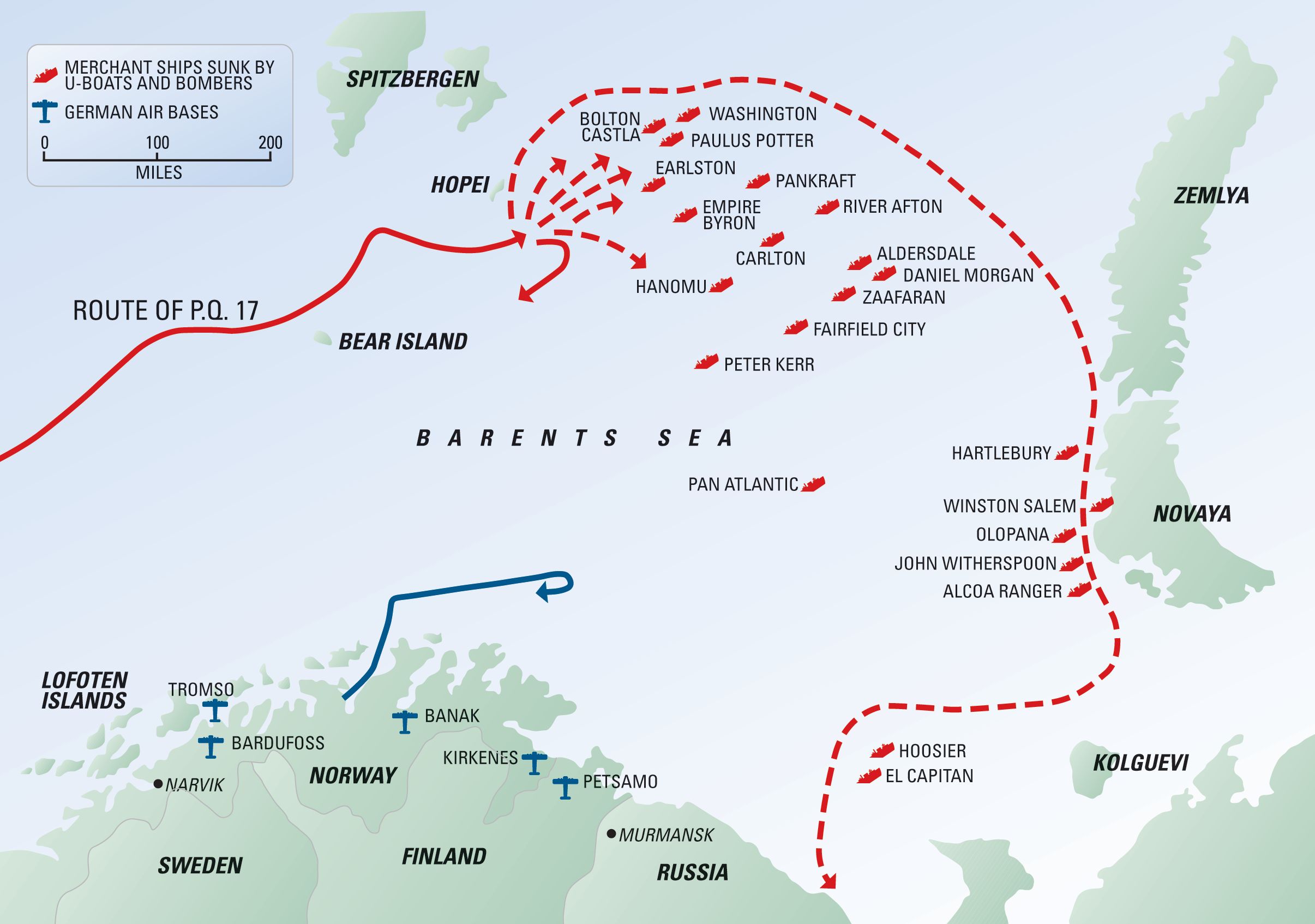
Other convoys that lost multiple ships have also been mapped and described. Convoy PQ-17, for instance, sailed for the Russian port of Arkhangelesk from Iceland in June/July 1942, lost 23 of its 35 merchant vessels to German U-boats and aircraft, and has also been written about (1, 2) and mapped (1, 2). But the majority of convoys have passed into obscurity.
This is not surprising as there were over 18,000 Allied convoys during the Second World War. Most of these convoys sailed undisturbed and arrived at their destinations unscathed. Of the 364 convoys that sailed as part of the HX series of convoys between September 1939 and May 1945, for instance, 299 did not lose any ship to Axis forces. In fact, close to 96% of the ships that sailed in these convoys arrived at their destination. Most of the ships that did not make the trip returned to the port of their origin due to mechanical or other issues. Less than 1% – 179 – of the 18,566 ships that sailed as part of an HX convoy were sunk due to enemy action. (Numbers have been compiled from Convoyweb).
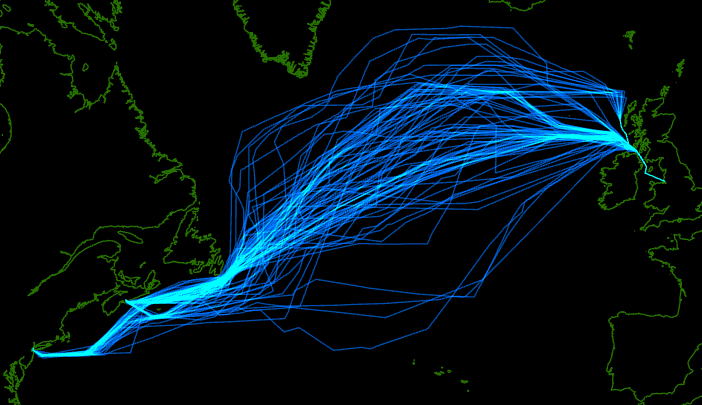
Maps for most convoys are difficult to find. This is understandable since most convoys arrived safely at their destinations without incident. But, though the maps of single convoys that had no losses might be somewhat mundane and dull to look at, collectively the alignment of their routes may tell a story.
About the World War II Convoy Atlas
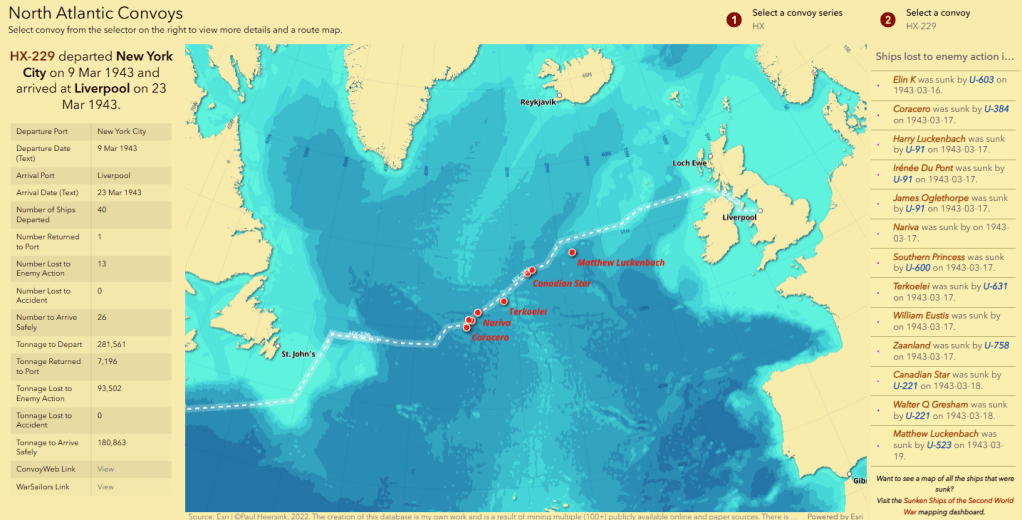
The World War II Convoy Atlas is a collection of convoy maps in an interactive dashboard. Included in the Atlas so far are the routes of 100 convoys. Aside from the maps, the dashboard includes summary information on each convoy and a listing of any ships that were sunk along its route. Though there were 18,461 Allied convoys that sailed during World War II I don’t expect to be mapping them all. But do expect to see the number of convoys mapped increase over the next few months.
Included on the map are the following convoy routes:
- HX 153 – 190, 192 – 239, 245
- MW 12
- ON 23, 127, 154, 166, 202
- ONS 5, 18, 24
- PQ 13
- SC 103, 107, 121, 122
Explore the World War II Convoy Atlas.
The Data Sources
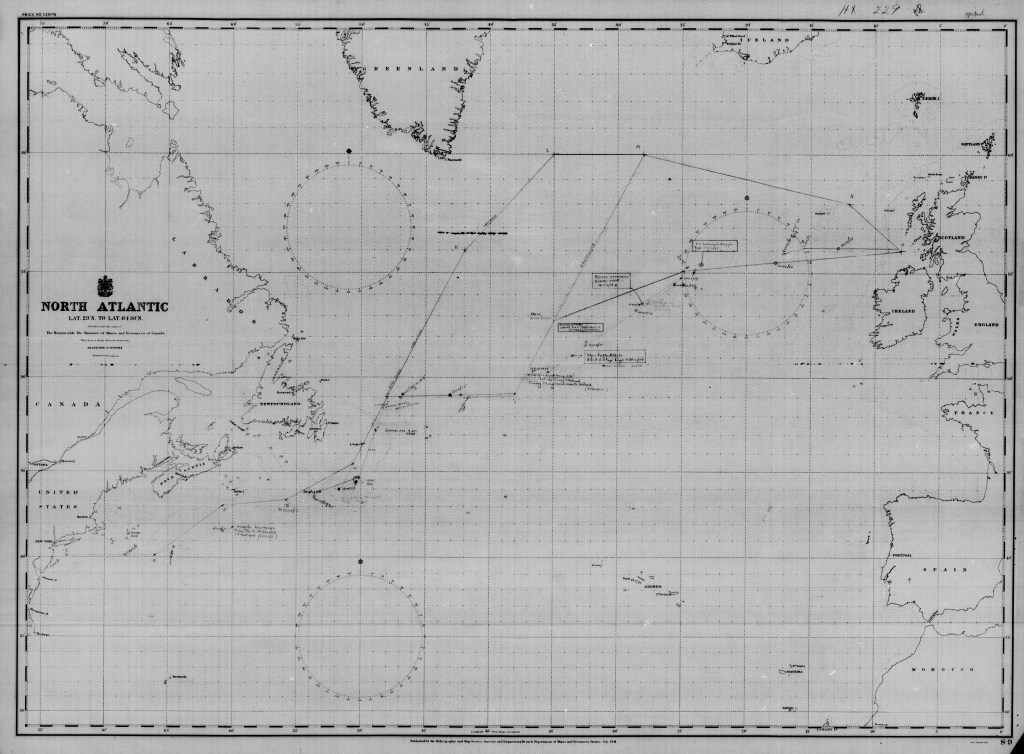
Much of the mapping information that is included in the Atlas comes from a single source I have recently discovered: the Royal Canadian Navy: Convoy Reports of Proceedings, 1939-1945. This collection includes messages between Canadian naval headquarters and the convoy commanders, convoy reports and maps on which both the planned and actual route of the convoy were plotted. This collection of wartime documents was captured on microfilm, after which the originals were destroyed. Library and Archives Canada has since digitized and published the microfilm.
Source: Library & Archives Canada
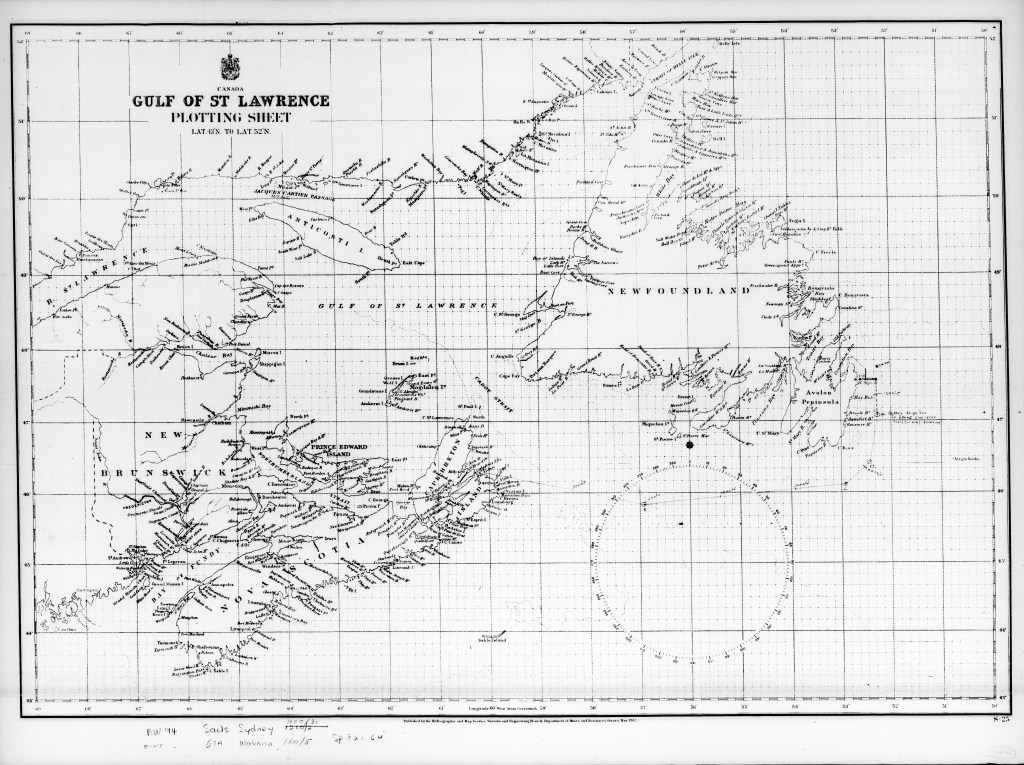
The collection contains over 223,000 images in 42 reels. There is no index to the images and the images are not searchable so finding specific content in the collection can be a challenge. The convoy maps, conveniently, appear in last 5 reels of the collection (C-5542 to C-5546). A complete list of the convoys mapped is provided the in table at the end of this post. The maps were published by the Hydrographic and Map Service in the Canadian government’s Department of Mines and Resources and were used by both merchant and naval vessels. The most common maps in the collection is one depicting the North Atlantic (example in the figure above) and one that depicts Atlantic Canada (see figure below). Captains and crewmembers would plot the expected route and the actual route, with dates and times. Sometimes additional notes were recorded to indicate events.
Putting the Atlas Together
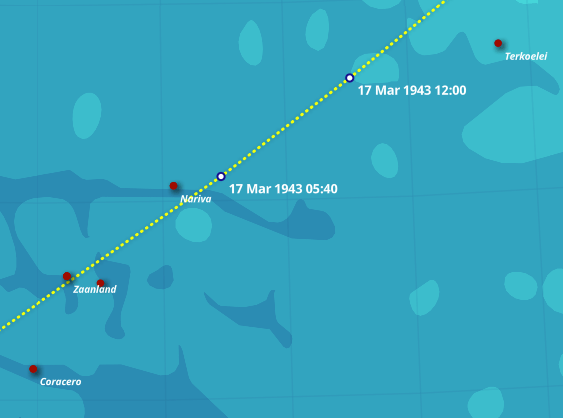
Creating the convoy data required the published maps in the Collection to be imported and geo-referenced before they could be digitized. Summary information compiled from data published on ConvoyWeb was added to the appropriate record. The Sunken Ships database was added to a map. Since it shares a common data field with the convoy data, both could easily be incorporated into an interactive dashboard. This could easily have been done in one dashboard – an initially was.
But I split up the Atlas into 3 pages and, much like a paper atlas, each page focuses on one area or theatre of operations. Each map has its own map projection – one that is more suitable to the area of interest than the usual Web Mercator. This was especially true for the Arctic convoy map where east – west distances are grossly distorted in Web Mercator. Because the content of my map was fairly simple to begin with and because I didn’t need the wealth of information that comes with a standard basemap, I could dispense with the usual Web Mercator projection.
Instead I cached one single layer – my bathymetry data (from Natural Earth) that happened to draw faster in cached format anyway – in the projection I selected for the map. Because I had three different maps, each with a different projection, I had to do this 3 times. The caching time is quick and the storage required to host the cache is minimal so this was not onerous.
The maps for each theatre were placed in their own dashboards and each dashboard was given its own page within an ArcGIS Online Experience Builder app. As an introduction, a StoryMap was created and placed on the first page. Because of the flexibility of the Experience Builder app, it can be easily expanded to include additional content and enables a stable url regardless of the content changes within it.
Index to the Library & Archives Canada convoy map collection
The following is a catalogue of the convoy maps that appear in the Library & Archives Canada collection published on Canadiana Héritage. Not all convoy sequences are complete.
| Convoy Series | Reel | Images |
| AT-54A – AT-212 | C-5542 | 1 – 275 |
| BA-13 – BA-18 | C-5542 | 276 – 281 |
| BS-9 – BS – 102 | C-5542 | 282 – 364 |
| BW-30 – BW-181 | C-5542 | 365 – 582 |
| BX-57 – BX-164 | C-5542 | 383 – 763 |
| CK-1 – CK-3 | C-5542 | 764 – 769 |
| CU-3 – CU-73 | C-5542 | 770 – 896 |
| FH-60 – FH-122 | C-5542 | 897 – 1044 |
| FH-122A – FH-179A | C-5543 | 1 – 80 |
| GS-24 – GS-68 | C-5543 | 81 – 160 |
| GUF-10 – GUF-22 | C-5543 | 161 – 187 |
| GUS-8 – GUS-92 | C-5543 | 188 – 339 |
| HF-59 – HF-111 | C-5543 | 340 – 497 |
| HHX-220 | C-5543 | 498 – 500 |
| HJ-29 – HJ-101 | C-5543 | 501 – 582 |
| HJF-1 – HJF-48 | C-5543 | 583 – 663 |
| HL – 1 | C-5543 | 664 – 665 |
| HS-91A – HS-227 | C-5543 | 666 – 869 |
| HX-154 – HX-238 | C-5543 | 870 – 1050 |
| HX-239 – HX-359 | C-5544 | 1 – 182 |
| HXF-290 – HXF-310 | C-5544 | 183 – 203 |
| HXM-287 – HXM-304 | C-5544 | 204 – 215 |
| HXS-288 – HXS-303 | C-5544 | 216 -228 |
| IUS-3 – IUS-5 | C-5544 | 229 – 235 |
| JH-56 – JH-121 | C-5544 | 236 – 357 |
| JHF-1 – JHF-59 | C-5544 | 358 – 452 |
| JN-34 – JN-38 | C-5544 | 453 – 463 |
| LN-1 – LN-30 | C-5544 | 464 – 497 |
| NA-1 – NA-13 | C-5544 | 498 – 517 |
| NL-14 – NL-31 | C-5544 | 518 – 556 |
| NY-10 – NY-170 | C-5544 | 557 – 589 |
| ON-23 – ON-287 | C-5544 | 590 – 1120 |
| ON-287 – ON-305 | C-5545 | 1 – 45 |
| ONF-232 – ONF-255 | C-5545 | 46 – 70 |
| ONM-153 – ONM-249 | C-5545 | 71 – 87 |
| ONS-1 – ONS-254 | C-5545 | 88 – 222 |
| OT-6 – OT-12 | C-5545 | 223 – 239 |
| QS-54 – QS-109 | C-5545 | 240 – 305 |
| SB-46 – SB-97 | C-5545 | 306-372 |
| SC-47 – SC-177 | C-5545 | 373 – 639 |
| SG-26 – SG-45 | C-5545 | 640 – 677 |
| SH-86A – SH-223A | C-5545 | 678 – 930 |
| SQ-36 – SQ-106 | C-5545 | 931-998 |
| SC-104 – SC-109 | C-5545 | 999 – 1010 |
| TA-50A – TA97A | C-5545 | 1011 – 1083 |
| TA-99A – TA-208A | C-5546 | 1 – 200 |
| TCU-23 – TCU-35 | C-5546 | 201 – 214 |
| TA-208B – TA-215 | C-5546 | 215 – 217 |
| TU-5 – TU-11 | C-5546 | 218 – 257 |
| UC-3 – UC-70B | C-5546 | 258-415 |
| UCT-23 – UCT-35 | C-5546 | 416 – 429 |
| UGF-9 – UGF-22 | C-5546 | 430 – 460 |
| UGS-10 – UGS-95 | C-5546 | 461 – 604 |
| UT-1 – UT-14 | C-5546 | 605 – 624 |
| WB-23 – WB-171 | C-5546 | 625 – 829 |
| XB-58 – XB-165 | C-5546 | 830 – 1011 |
| YD-2 – YD-4 | C-5546 | 1012 – 1017 |
 Sunken Ships of the Second World War