The Danish merchant fleet’s history is varied with ships at one time being laid up, in neutral, Allied and Axis hands. Totaling 868,797 tons when the war began on September 1, 1939, by the end of the war it had been reduced by 44%.
The Sankey diagram explains the demise of the Danish merchant fleet’s in World War II.
Much of the Germans success against Allied shipping can be rightfully attributed to their submarine fleet. Of the close to 5,000 vessels the Germans sank, 2,939 of them can be attributable to the Kriegsmarine’s submarine arm. Far behind in number but still significant are the number of ships sunk by the Luftwaffe: 1,312.
Much of this, of course, occurred in-shore along the coast of the British Isles or in the Mediterranean but the Luftwaffe did have some success with the Allies’ trans-Atlantic supply route. There the Germans employed their only long-range bomber, the 4-engined Folke-Wulf 200 Condor, with some success. With a range of 3,560 kilometres the bombers could reach out almost the middle of the Atlantic Ocean, at least at one point.
The map above shows the location of some of the 1,312 ships that were sunk by Luftwaffe aircraft. The dashed blue line indicates the approximate range of the Folke-Wulf 200. Another 413 vessels remain unmapped but most of these were in Allied harbours.
In late 1939 the German cruiser Admiral Graf Spee went on a raiding journey in the South Atlantic and sunk 9 merchant vessels before encountering the Royal Navy cruisers Exeter, Ajax and Achilles and being cornered in Montevideo, Uruguay. In the middle of this journey, Captain Langsdorff of the Admiral Graf Spee took the ship around the southern tip of Africa and sunk the Africa Shell off the coast of Mozambique before doubling back and returning to the South Atlantic., hoping to confuse his opponents and put them off the chase.
Africa Shell, a smaller tanker of 706 tons, was sighted by the Admiral Graf Spee as it was heading south along the coast for its final destination of Lourenco Marques, still some 170 nautical miles (320 kilometres) away to the southwest. According to the captain of the Africa Shell, Patrick Dove, once the Admiral Graf Spee was sighted, the Africa Shell turned to towards the shoreline in the hopes of escaping into neutral waters. Mozambique was a Portuguese colony at the time and Portugal was officially neutral.
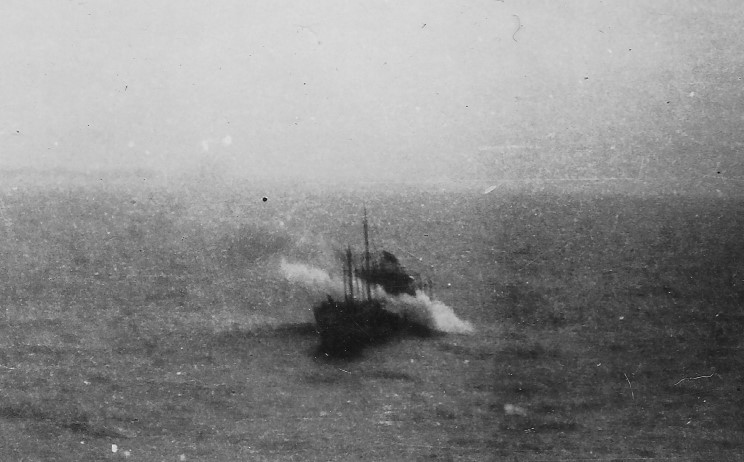
The sinking of the Africa Shell. Photo via MaritimeQuest
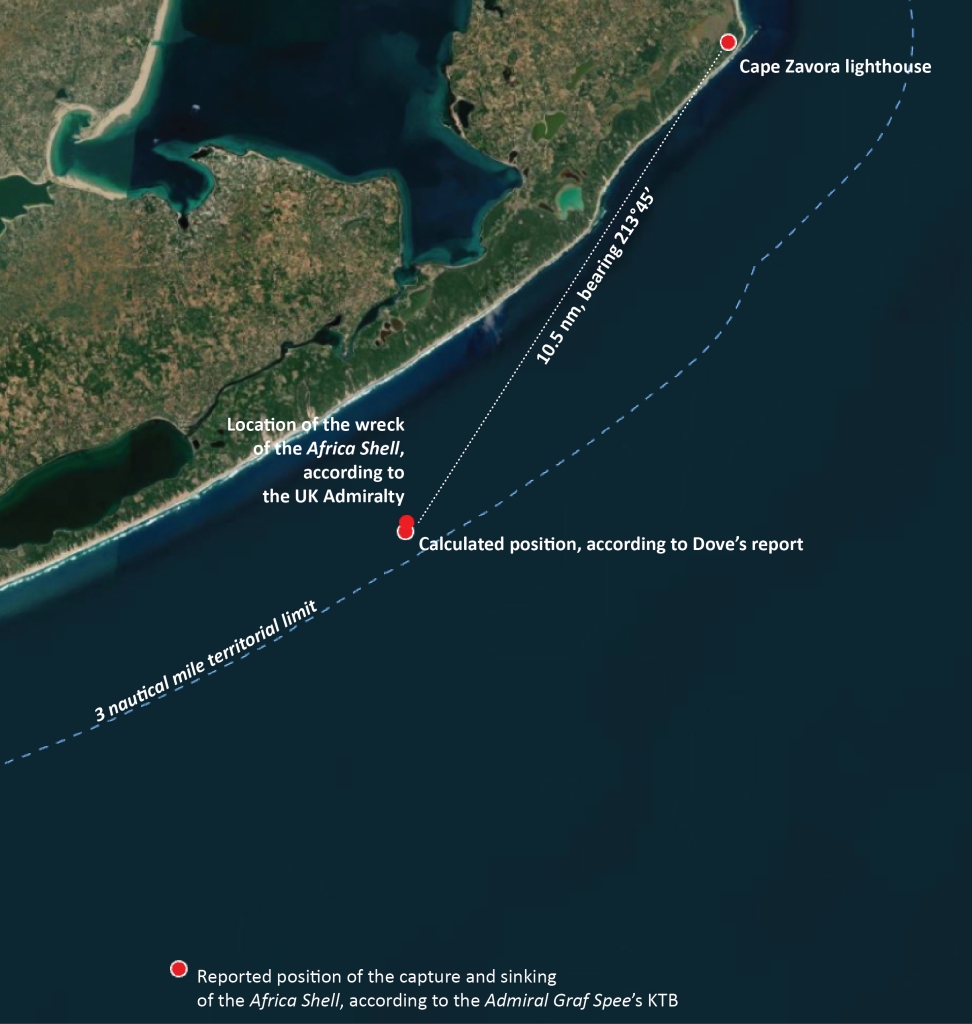
Dove writes in his book I Was Graf Spee’s Prisoner that his orders to his navigation officer “were to take the most careful bearings and make a full record of them on paper. I myself checked these bearings.”[1] He insists that the ship was a half mile within the 3 nautical mile limit. Elsewhere in his book he states that “according to the bearings taken by my second officer my position was ten-and-a-half miles southwest by south from Cape Zavora lighthouse, and my vessel was two-and-a-half miles from the shore, and therefore inside the territorial limits of Portuguese East Africa.”[2] The UK Admiralty’s database of wrecks and obstructions puts the location of the Africa Shell at 24° 40′ 00″ South 35° 30′ 03″ East, about 370 m from this location.
The Germans always maintained that the Africa Shell was captured and sunk outside the 3 mile nautical limit so it is no surprise that the location of these events is different in the Admiral Graf Spee’s Kriegstagebücher or war diary (KTB). There Captain Langsdorff of the Admiral Graf Spee records that on November 15, 1939 at 14:06, the Admiral Graf Spee captured and sunk the Africa Shell at 24° 48′ South, 35° 01′ East.[3] This is approximately 9.7 nautical miles (18 km) from Dove’s stated position and 8.4 nm (15.5 km) from the Mozambique shoreline.
Of course, location measurement wasn’t an exact science in 1939 as it is today with GPS units and cellphones that give you a fairly precise location. If the weather was rough or the skies overcast, it could be tough or impossible to take any reading. Even on a good day measurements using a sextant – the instrument of the time – were +/- a half mile or so. Dove and his navigator could easily have been off as might have the Admiral Graf Spee. On top of that, both parties were motivated to state the accuracy of their claim so some allowances might have been made.
To my knowledge, the exact location of the wreck of the Africa Shell has not been mapped. Doing so would go far in clarifying whether or not the ship was sunk within territorial waters. However, even if the ship was sunk within territorial waters, it would have been unlikely to have had much affect on events. The Portuguese government might have sent a letter of protest to the German government and the Germans might have at the most, made a half-hearted apology. In any case, by the time that would have happened, the Admiral Graf Spee would have long disappeared again into the South Atlantic.
[1]I Was Graf Spee’s Prisoner, Patrick Dove, Viking Press, 1956, p.93
One of the interesting things about mapping all of the ships sunk during the Second World War are the spatial and temporal patterns they make. Mapping each shipwreck provides a simple outline of coastlines but creating an animated map that steps through the entire way day by day or month by month results in a map that shows the changing fortunes of war.
The map above shows the expansion of the war from European waters as the war progresses. By late 1941 the war had become a truly world war with the Japanese attack on Pearl Harbor. The German u-boat attacks along the east coast of the US and into the Gulf of Mexico become prominent in early 1942. What amazes me every time are the sheer number of Japanese vessels sunk by the end of the war in the western Pacific.
I must confess: I was wrong. In last month’s update blog post I said that “These days, since I seemed to have mined most of what is available online there aren’t many changes.” Well, this month I stumbled across an entirely new source of data.
I am referring to the UK Hydrographic Office’s Admiralty Maritime Data Solutions. There they offer a shapefile of 94,000 wrecks from around the world for hundreds of years. Filtering out only those ships that were sunk between 1939 and 1945 leaves about 4,000 records. Though the wrecks can be found all around the world, the majority of the shipwrecks in the database for the time period that I am looking at are around the UK (see map), not surprisingly. I am happy to report that it appears that I have 97% of the shipwrecks on their list.
The UK Hydrographic data isn’t perfect. There are duplicate records, records putting ships well inland and a number that are listed as NameProbably? But it’s another data source and it has inspired me to dig deeper on some of the wrecks.
As a result, this month’s update is considerable:
54 additions (not all because of the UK Hydrographic list)
4 deletions (all duplicates)
387 records were moved to more accurate locations
5 other edits
I expect the next month or two to be similar as I wade through the remaining 2/3 of the data.





 Sunken Ships of the Second World War