The Danish merchant fleet’s history is varied with ships at one time being laid up, in neutral, Allied and Axis hands. Totaling 868,797 tons when the war began on September 1, 1939, by the end of the war it had been reduced by 44%.
The Sankey diagram explains the demise of the Danish merchant fleet’s in World War II.
The Belgian merchant ship Bruxelles, 5,085 tons, sunk on June 9, 1942
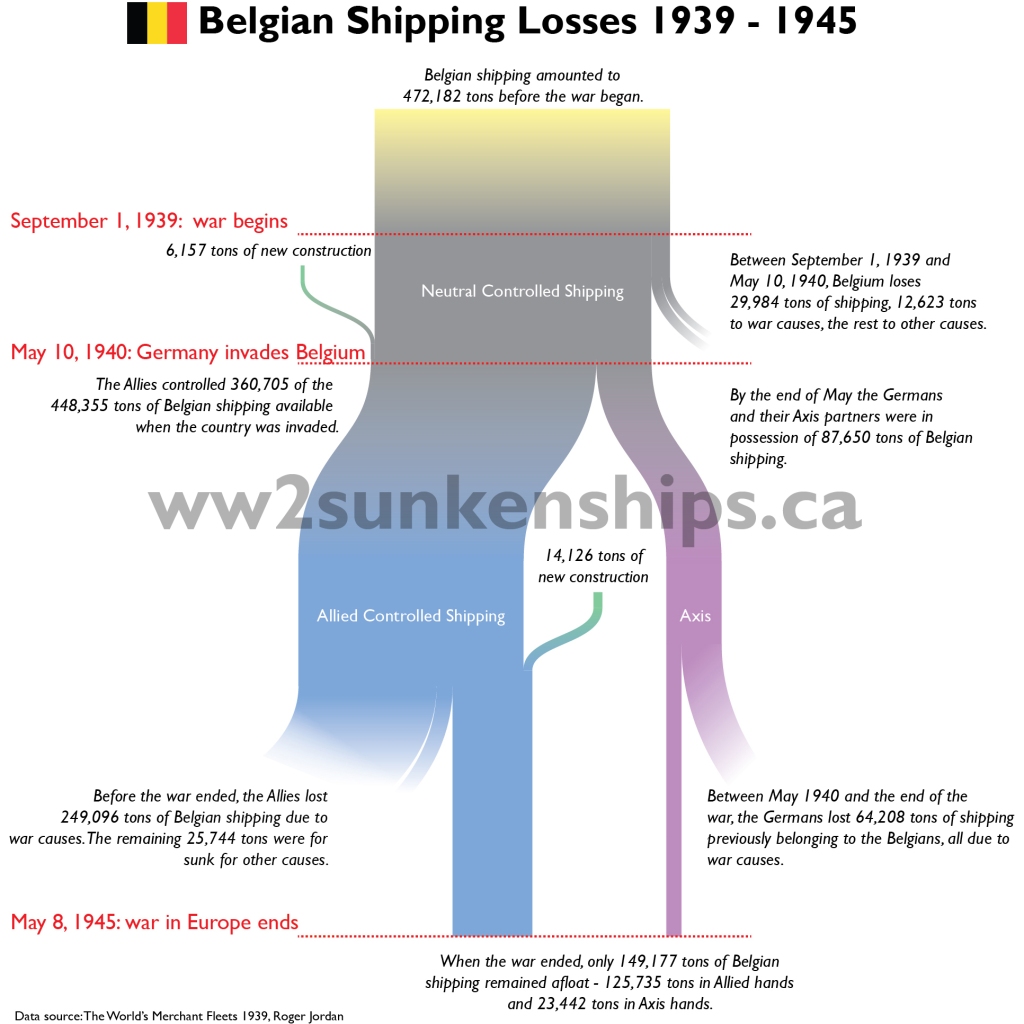
Belgium was a relatively minor player in the Second World War, both on land and on the sea. At the start of the war in September 1939, it boasted a merchant fleet of only 472,182 tons – well behind the UK, the undisputed world leader in shipping at the time with 16.6 million tons. In the period of September 1939 to May 1940 before Belgium was invaded by the Germans and the country joined the Allied cause it had already lost close 30,000 tons of shipping to accidents, mines and German torpedoes (even though it was officially neutral).
When Belgium surrendered to the Germans on May 28, 1940 only a small part of its merchant fleet fell into German hands – about 71,000 tons – while the majority – 358,000 tons – continued to serve the Allies. The Germans steadily whittled away at this disadvantage throughout the war so that by the end of the war, only about 108,000 tons of Belgian shipping in Allied control remained afloat. Of the 71,000 tons the Germans had captured, only 21,000 tons managed to survive the war. In the end, only 27% of the Belgian merchant fleet that existed at the start of the war survived to the end.
The sankey chart below provides a breakdown of the status of the Belgian fleet during the course of the war.
This 52 minute documentary sheds light why it is good to know where the sunken ships of the Second World War are. Though it grossly underestimates the number of sunken vessels as a result of that conflict (8,500 over 400 tons – in reality that number is around 12,800), it is a wonderful blend of mapping, history and environmental science that illuminates the value of my project of mapping the location of every ship sunk in the Second World War.
Much of the Germans success against Allied shipping can be rightfully attributed to their submarine fleet. Of the close to 5,000 vessels the Germans sank, 2,939 of them can be attributable to the Kriegsmarine’s submarine arm. Far behind in number but still significant are the number of ships sunk by the Luftwaffe: 1,312.
Much of this, of course, occurred in-shore along the coast of the British Isles or in the Mediterranean but the Luftwaffe did have some success with the Allies’ trans-Atlantic supply route. There the Germans employed their only long-range bomber, the 4-engined Folke-Wulf 200 Condor, with some success. With a range of 3,560 kilometres the bombers could reach out almost the middle of the Atlantic Ocean, at least at one point.
The map above shows the location of some of the 1,312 ships that were sunk by Luftwaffe aircraft. The dashed blue line indicates the approximate range of the Folke-Wulf 200. Another 413 vessels remain unmapped but most of these were in Allied harbours.