April 2023 Updates

Updates for the month:

  • 129 records edited (additional links, spelling corrections)
  • 228 records moved to better locations
  • 2 records deleted
  • 20 new additions

The following vessels were added to the database:

  • V 87 Aosta, sunk 18 February 1942 in the Mediterraean between Tunisia and Sicily
  • Ariosta, sunk 15 February 1942 off the coast of Tunisa
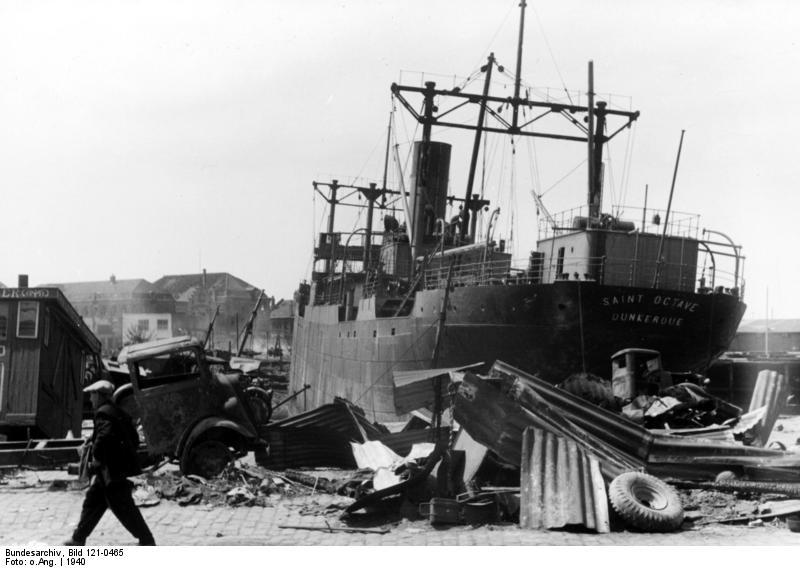
  • Saint Octave, sunk 29 May 1940 at Dunkirk
  • Royal Daffodil II, sunk 7 May1941 at Liverpool – more on Instagram
  • Baicin, sunk 27 February 1943 in the Ligurian Sea
  • Balena, sunk 16 February 1942 in the Bay of Biscay
  • Bella Italia, sunk 9 April 1943 off the southeast coast of Sardinia
  • Ben Hur, sunk 13 July 1943 off the coast of Italy northwest of Livorno
  • Cressdene, sunk 17 March 1942 off the coast of England east of Harwich
  • Buenos Aires II, sunk 8 November 1942 off the coast of Libya
  • Cadamosto, 22 December 1941 off the coast of Libya
  • Capodoglio, 26 September 1941 off the coast of Libya
  • Carlo Splendor, 7 July 1943 off the east coast of Sicily
  • Carlotta, sunk 19 June 1942 off the coast of Montenegro
  • Pearl, sunk 17 December 1939 in the North Sea
  • Cinzia, sunk 20 January 1943 off the coast of Libya
  • Città di Agrigento, sunk 20 July 1942 at Mersa Matrouh, Egypt – more on Instagram
  • Colombo, sunk 16 April 1944 in the Gulf of Taranto
  • Dungeness, sunk 15 November 1940 off the coast of Norfolk, UK
  • Constantina, sunk 20 December 1942 off the coast of Tunisia

Visit the dashboard to see them all! Or use the Find-A-Ship app.

Saint Octave in the midst of the wreckage of the recently departed British Expeditionary Force at Dunkirk, August, 1940

Luftwaffe Maritime Successes

FW-200C-1 Condor via AirVectors

Much of the Germans success against Allied shipping can be rightfully attributed to their submarine fleet. Of the close to 5,000 vessels the Germans sank, 2,939 of them can be attributable to the Kriegsmarine’s submarine arm. Far behind in number but still significant are the number of ships sunk by the Luftwaffe: 1,312.

Much of this, of course, occurred in-shore along the coast of the British Isles or in the Mediterranean but the Luftwaffe did have some success with the Allies’ trans-Atlantic supply route. There the Germans employed their only long-range bomber, the 4-engined Folke-Wulf 200 Condor, with some success. With a range of 3,560 kilometres the bombers could reach out almost the middle of the Atlantic Ocean, at least at one point.

The map above shows the location of some of the 1,312 ships that were sunk by Luftwaffe aircraft. The dashed blue line indicates the approximate range of the Folke-Wulf 200. Another 413 vessels remain unmapped but most of these were in Allied harbours.

Animated Map of Sunken Ships

One of the interesting things about mapping all of the ships sunk during the Second World War are the spatial and temporal patterns they make. Mapping each shipwreck provides a simple outline of coastlines but creating an animated map that steps through the entire way day by day or month by month results in a map that shows the changing fortunes of war.

The map above shows the expansion of the war from European waters as the war progresses. By late 1941 the war had become a truly world war with the Japanese attack on Pearl Harbor. The German u-boat attacks along the east coast of the US and into the Gulf of Mexico become prominent in early 1942. What amazes me every time are the sheer number of Japanese vessels sunk by the end of the war in the western Pacific.

Enjoy!

January 2023 Updates

I must confess: I was wrong. In last month’s update blog post I said that “These days, since I seemed to have mined most of what is available online there aren’t many changes.” Well, this month I stumbled across an entirely new source of data.

I am referring to the UK Hydrographic Office’s Admiralty Maritime Data Solutions. There they offer a shapefile of 94,000 wrecks from around the world for hundreds of years. Filtering out only those ships that were sunk between 1939 and 1945 leaves about 4,000 records. Though the wrecks can be found all around the world, the majority of the shipwrecks in the database for the time period that I am looking at are around the UK (see map), not surprisingly. I am happy to report that it appears that I have 97% of the shipwrecks on their list.

The UK Hydrographic data isn’t perfect. There are duplicate records, records putting ships well inland and a number that are listed as NameProbably? But it’s another data source and it has inspired me to dig deeper on some of the wrecks.

As a result, this month’s update is considerable:

  • 54 additions (not all because of the UK Hydrographic list)
  • 4 deletions (all duplicates)
  • 387 records were moved to more accurate locations
  • 5 other edits

I expect the next month or two to be similar as I wade through the remaining 2/3 of the data.

See the new additions and changes on the map!

December 2022 Updates

There were no updates to the database in November but a few in December:

  • 3 records had edits to the date the ship sunk
  • 5 records were moved to more accurate locations
  • 1 new record was added

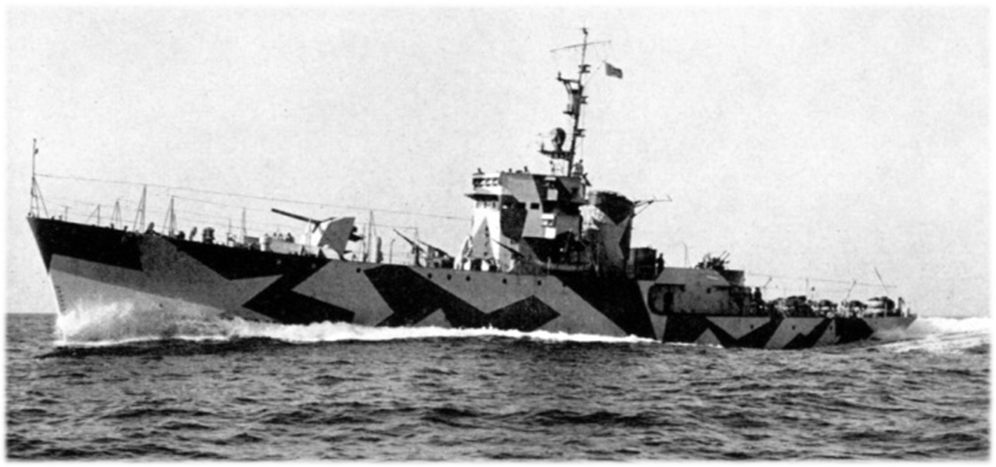
These days, since I seemed to have mined most of what is available online there aren’t many changes. But occasionally I do come across information that allows me to add in a new record. That was the case for the German corvette UJ 201 Egeria. krnicadive.com has a few shipwreck locations listed on its site, all within the Adriatic off its east coast. One of them was the Egeria. Included on the site is a detailed description of the events that led to its destruction on the last day of February, 1944. For a shortened description of the events, visit my Instagram post on the ship.

UJ 201 Egeria in happier days

Find the ship (and others) on the map.

September 2022 Updates

Updates this month:

  • 92 ships added to the map
  • 31 corrections to ship locations
  • 2 edits to ship records
  • 3 deletions
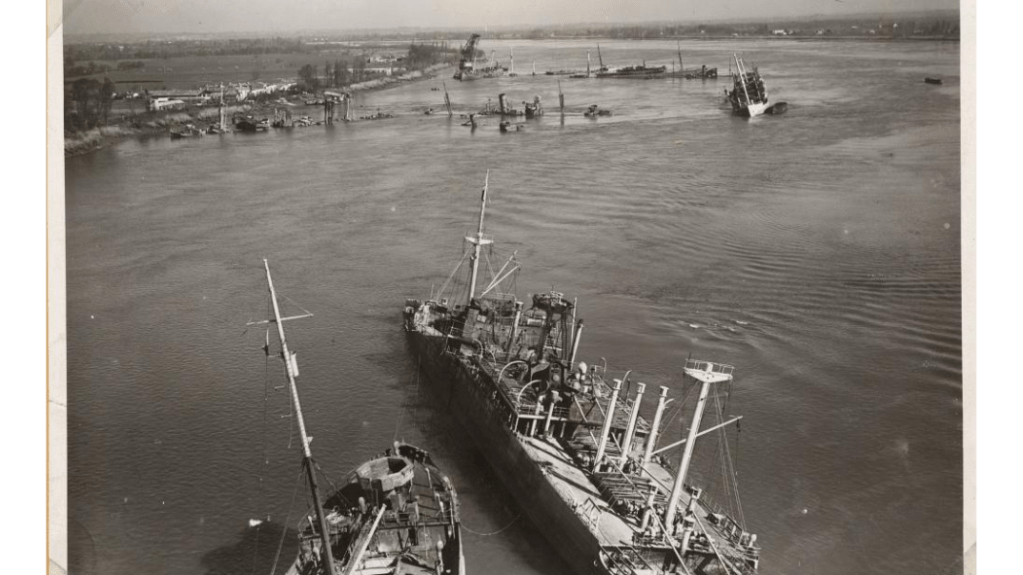
Some of the vessels sunk in the Garonne near Bordeaux in 1944

Most of the changes were tied to updated to ship sinkings around Bordeaux, France and Genoa, Italy. This is likely to be the last large update for some time.

Current total number of sunken ships mapped: 15,165

Current number of sunken ships on record but not mapped (due to no or inexact locations): 4,927

Check out the updated map and dashboard here.

Cap Corse, 1944

Frequently in my work I find a location for a sunken ships that is simply listed by the name of the harbour in which it sank. As the western Allies progressed on to the mainland of Europe, the Germans often sought to make whatever they left behind as useless as possible. Harbours, of course, were eminently useful to whoever had control of them and so they scuttled numerous ships in an effort to block the harbour and make any cleanup of them a long and arduous process (see Mud, Muscle, and Miracles: Marine Salvage in the United States Navy for a description of some of the challenges).

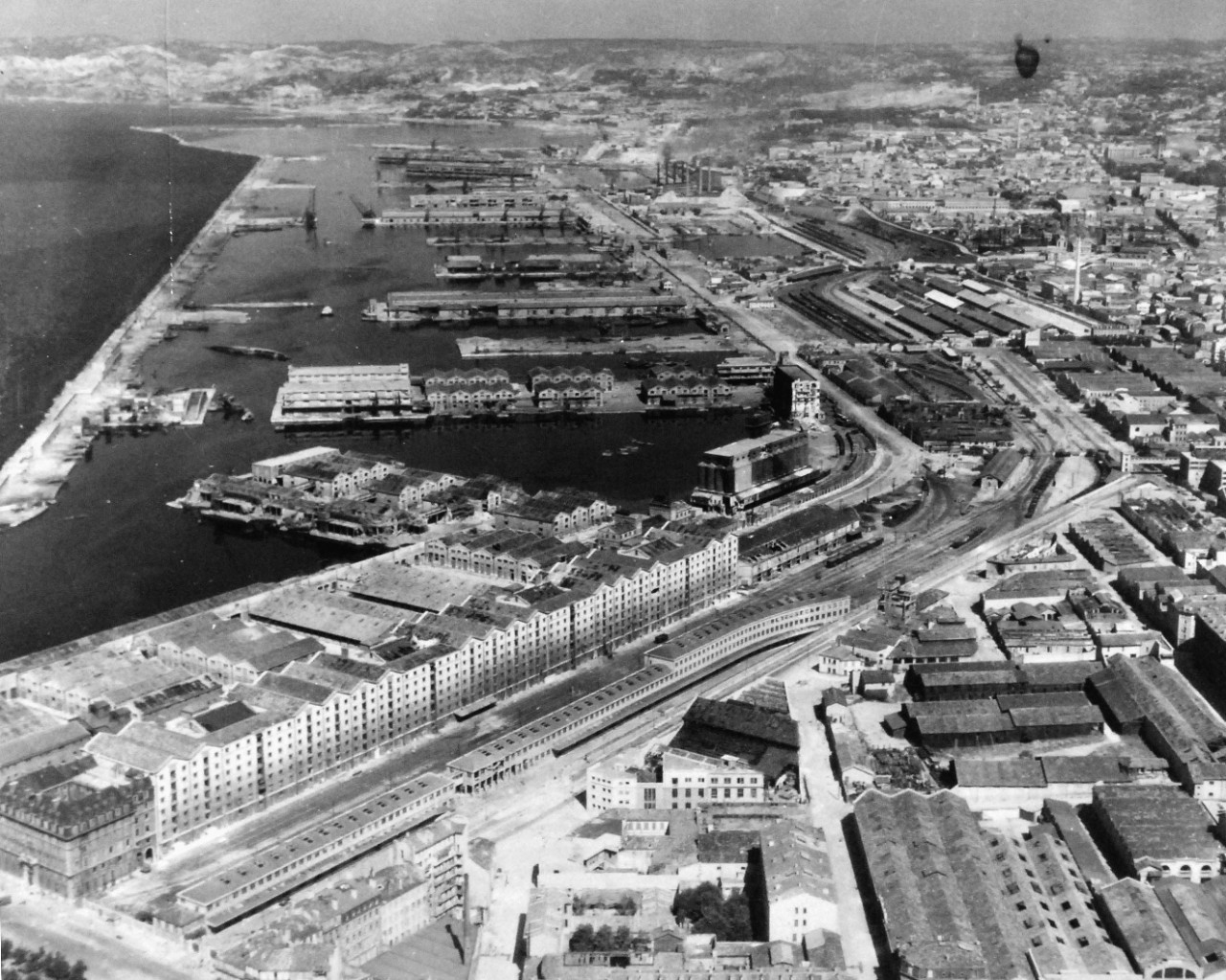
Aerial view of the harbour at Marseille, France in 1944. Note the two ships on the left-hand side of the photo (yet to be identified).

This was also the case for Marseille, France in the summer of 1944 where, according to a caption of another wrecked ship, 192 ships were wrecked (many presumably sunk). Unless there is a convenient map that displays both the names and the location of each wreck, determining the exact location for each sunken ship can be a monumental challenge.

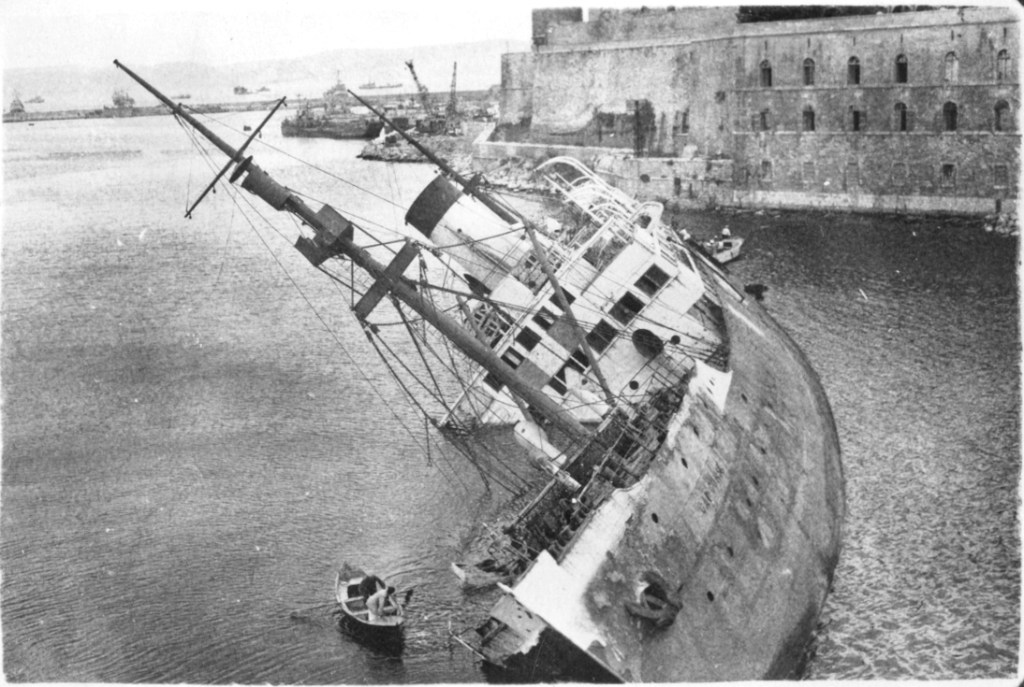
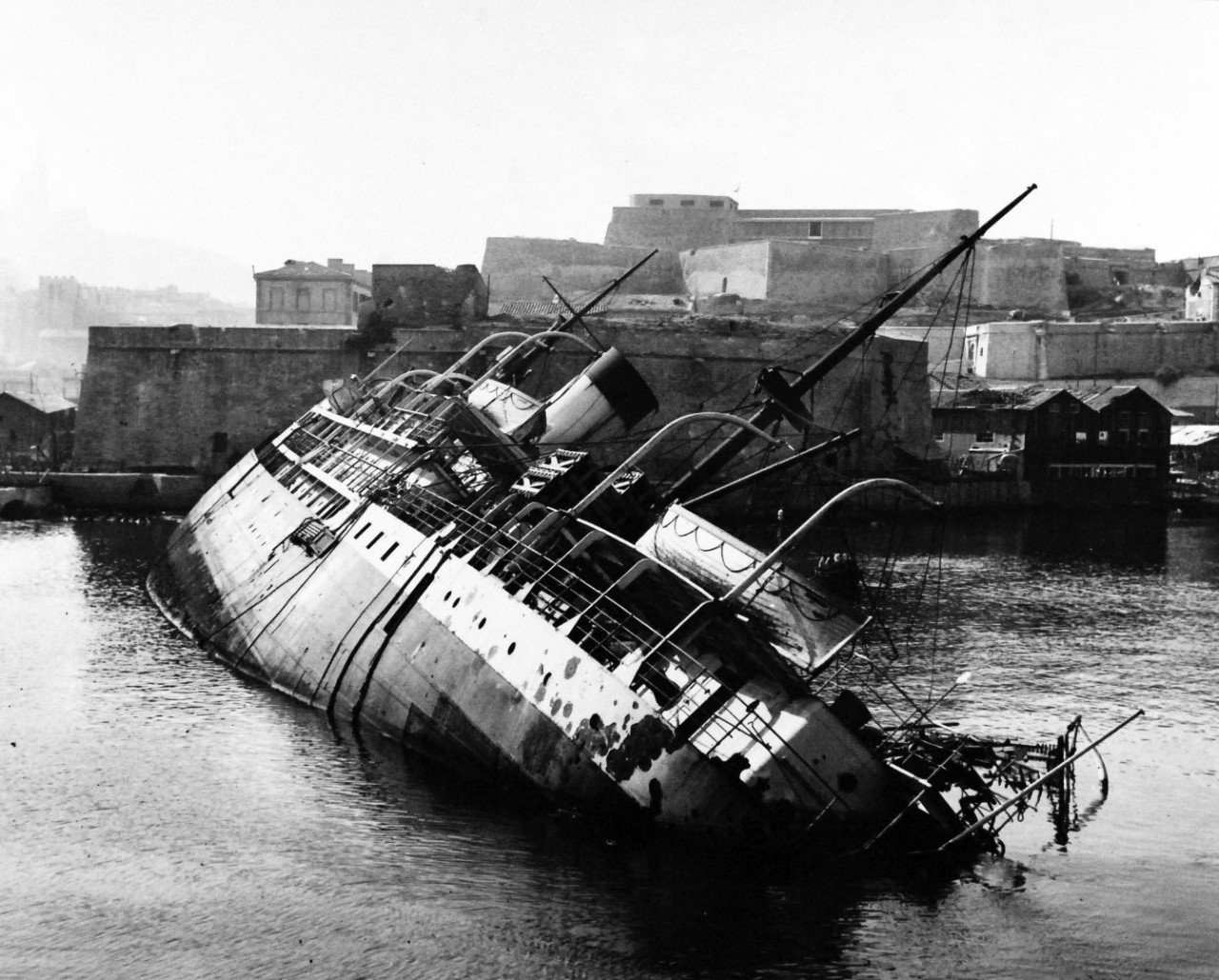
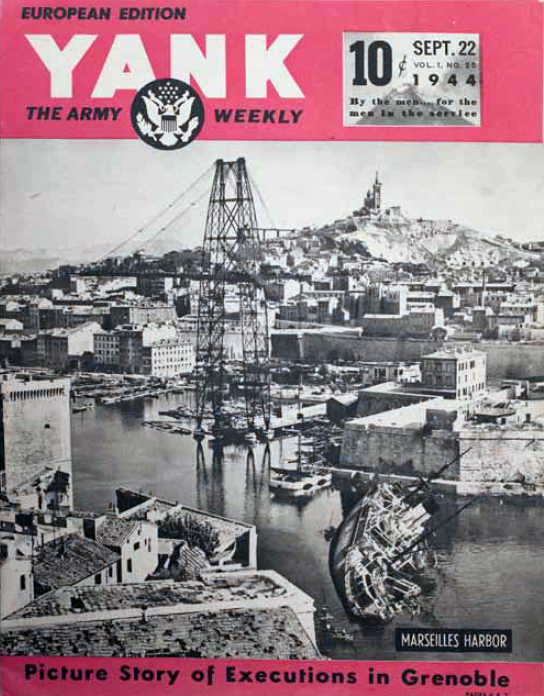
Cap Corse, a French cargo ship appropriated by the Germans during the Second World War, was scuttled by the retreating Germans at the entrance to Marseille’s old port. With a couple of strategically angled photos, it’s exact location was fairly easy to determine.

The Cap Corse on its side before Marseille’s Fort Saint Jean. Image source: Inch High Guy

I came across the image above from another blog site, Inch High Guy, where the ship is identified as the Cap Corse. Subsequently, I found other photos of the same ship from different angles to confirm the sunken ship’s resting place before it was cleared away. Below is one such photo of the same ship, but looking from the other side of the channel.

Cap Corse looking south. Source: National Museum of the U. S. Navy

A broader perspective is shown on the cover of Yank magazine below:

Frisco, sunk in 1944

Rarely does it happen that the wreck of a ship sunk during the Second World War is still visible today. Frisco, an Italian cargo ship of 4,610 tons, was scuttled in late August, 1944 by German troops and is currently sitting in shallow water in the Gironde, making it easily visible – and easy to map.

Frisco as viewed from the shoreline. Image via Reddit
Image via Google Maps

The ship is viewable on Google Maps and other online map providers (Google seems to have the best imagery for it – see to the right). See for yourself.

July 2022 Updates

A number of updates were made to the sunken ships database. These include:

  • 35 records added to the database
  • 2 records deleted from the database
  • 29 records had their locations updated
  • 2 records had either a name change (misspelling) or a date change

View all these updates and the rest of the database on the mapping dashboard, available here.